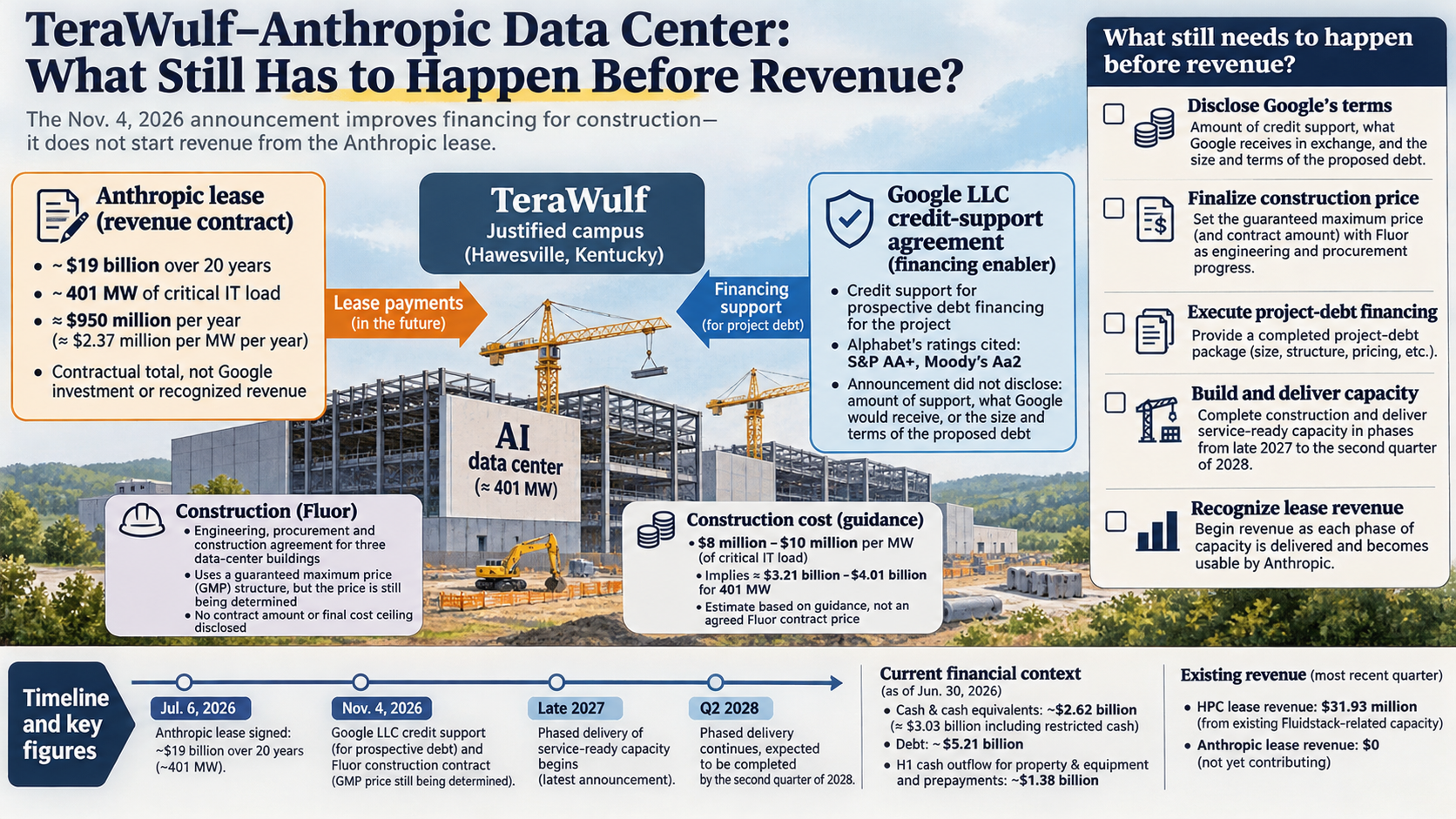
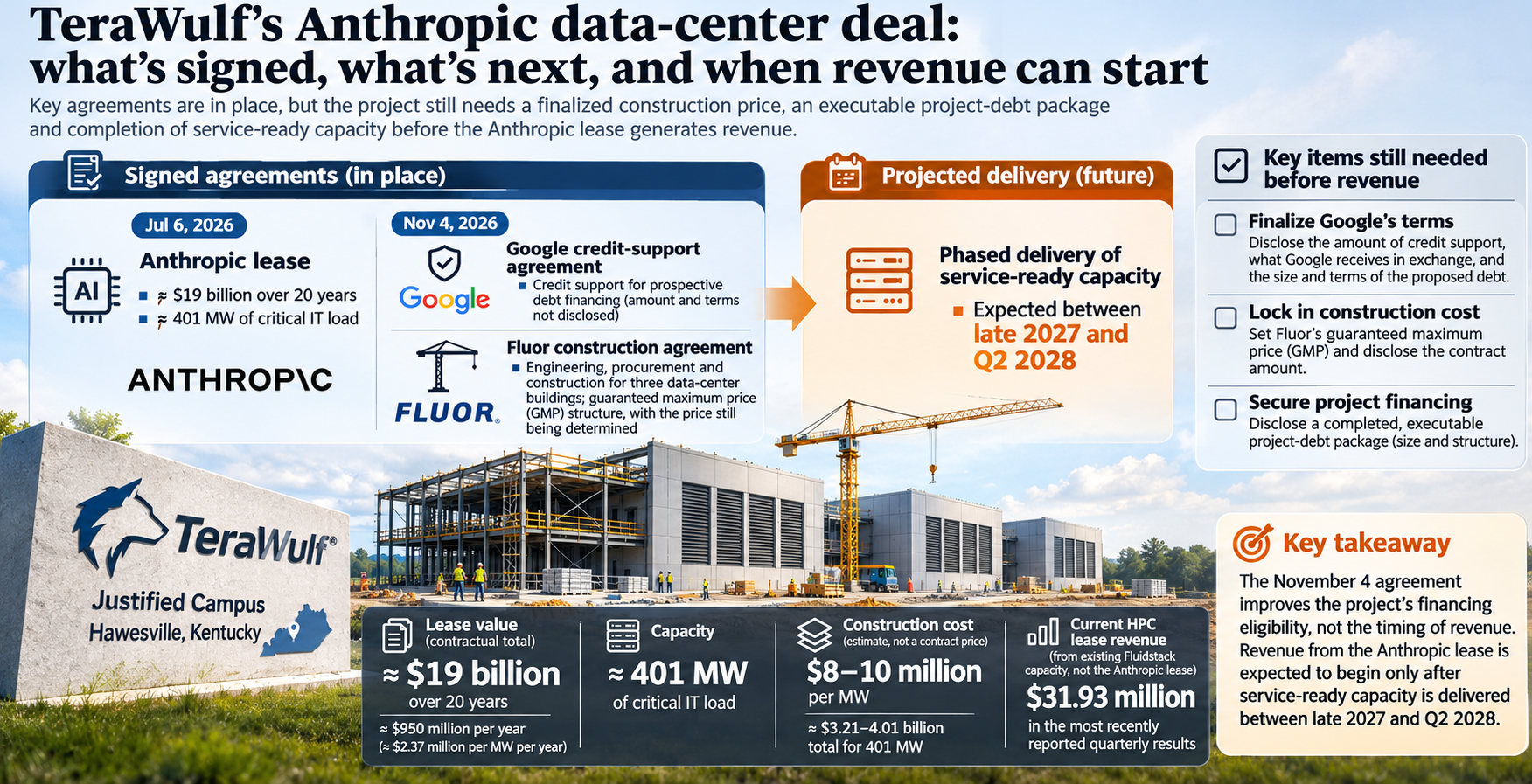
What still has to happen before TeraWulf’s Anthropic data-center lease produces revenue? As reported on November 6, 2026, the company had secured credit support for prospective debt financing and signed a construction contract. It had not disclosed a completed project-debt financing, a final construction price or revenue from the Anthropic lease.
The distinction matters for a company moving from Bitcoin mining toward large-scale AI infrastructure. TeraWulf’s November 4 agreement with Google LLC provides credit support for anticipated debt financing at its Justified campus in Hawesville, Kentucky. The announcement cited Alphabet’s AA+ rating from S&P and Aa2 rating from Moody’s. It did not disclose the amount of support, what Google would receive in exchange, or the size and terms of the proposed debt.
Lease value versus operating cash flow
TeraWulf’s July 6, 2026 lease with Anthropic represents approximately $19 billion over 20 years for facilities designed around roughly 401 MW of critical IT load. That is a contractual total, not a Google investment or recognized revenue. Dividing it evenly yields about $950 million a year, or approximately $2.37 million per MW per year; actual revenue depends on delivery of usable capacity.
The November announcement put phased delivery of service-ready capacity between late 2027 and the second quarter of 2028. That is later than the July announcement’s expectation that initial capacity would come online in the second half of 2027 and all capacity in early 2028. As of the original reporting date, the Anthropic lease had contributed no recognized revenue. TeraWulf’s most recently reported quarterly high-performance-computing lease revenue—$31.93 million—came from existing Fluidstack-related capacity, not this project.
Construction cost remains an open input
TeraWulf also signed a formal engineering, procurement and construction agreement with Fluor Enterprises for three data-center buildings. It uses a guaranteed maximum price structure, but the announcement said that price was still being determined as engineering and procurement progressed. Neither the contract amount nor a final cost ceiling was disclosed.
The company’s construction-cost guidance of $8 million–$10 million per MW of critical IT load implies roughly $3.21 billion–$4.01 billion for 401 MW. That is an estimate based on guidance, not an agreed Fluor contract price. On June 30, TeraWulf reported about $2.62 billion in cash and cash equivalents, or about $3.03 billion including restricted cash, against approximately $5.21 billion in debt. Its first-half cash outflow for property and equipment purchases and prepayments was $1.38 billion. Those figures show why the amount, cost and timing of project financing matter; they do not establish that the proposed debt has been issued.
Google had participated in a different TeraWulf arrangement in August 2025: two rounds of support connected to Fluidstack leases totaled $3.2 billion and were associated with 73.5 million warrants. That precedent does not establish the price or warrant terms of the November 2026 agreement. The immediate questions, as framed at the November 6 reporting date, were whether subsequent disclosures would specify Google’s terms, fix Fluor’s maximum price and set out an executable project-debt package.