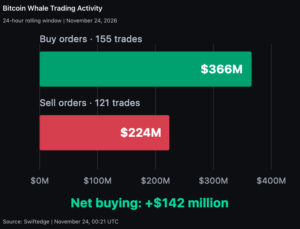
As of November 20, 2026, the question for Bitcoin was not simply whether selling pressure had eased after November’s decline. It was whether new cash buyers would take the place of liquidated leveraged positions. In a report looking ahead to May 2027, HTX Research argued that BTC could first stabilize, but that sustained recovery would depend on capital flows.
Price has recovered faster than participation
Crypto’s total market capitalization rose 39.6% quarter over quarter in the third quarter, according to the report, without a comparable increase in spot trading. HTX Research said BTC had returned to a $62,000–$66,000 range it identified as a recent buyer cost basis, while new cash demand had yet to emerge.
The funding indicators were weak. Farside data cited in the report showed $2.579 billion in cumulative net outflows from U.S. spot Bitcoin ETFs from November 2 through November 17. DeFiLlama data showed the stablecoin market capitalization down 5.33% over the 30 days to November 18.

Financing conditions may set the pace
HTX Research argued that the duration of restrictive financial conditions mattered more over the following six months than any single interest-rate decision. It noted that financing costs could rise if expectations for easing were pushed back, even without another Federal Reserve rate increase. It also distinguished easing alongside cooling inflation and stable incomes from rate cuts prompted by a sharp deterioration in demand.
The report pointed to a U.S. Treasury estimate of $800 billion in net privately held marketable borrowing in the first quarter of 2027. If more issuance came at longer maturities, HTX Research said, a higher term premium could push up long-term yields. It identified the February 2027 quarterly refinancing as a test of that possibility.
The report also flagged December 10, 2026, when a Federal Reserve decision and November CPI data were due on the same day. In its view, an initial rally after those events might reflect position adjustments rather than fresh allocations, which can take longer to pass through investment committees and fund subscriptions.
What would make a rebound durable?
Institutional channels can remove expected demand without outright BTC sales, the report warned: a narrower share-price premium or more expensive financing could constrain listed Bitcoin treasury companies. HTX Research proposed watching their ability to raise funds after the MSCI adjustment scheduled for November 30, 2026. To illustrate the scale of institutional flows, it estimated that roughly $240 million in ETF net outflows on November 17 was about eight times the nominal value of Bitcoin’s daily new block subsidies.
HTX Research said the better test of stabilization would come during pullbacks: whether each decline produced fewer forced sellers and each rebound attracted more cash buying. It identified the March 2027 quarterly expiry as a potential stress test for ETF subscriptions, spot-market depth and financing conditions.
These are the report’s scenarios, not outcomes already established. HTX Research said spot net buying, improved financing and growth in actual use could turn a rebound into a longer expansion. If the recovery relied mainly on short covering and renewed leverage, BTC could instead retest the cost-basis range.