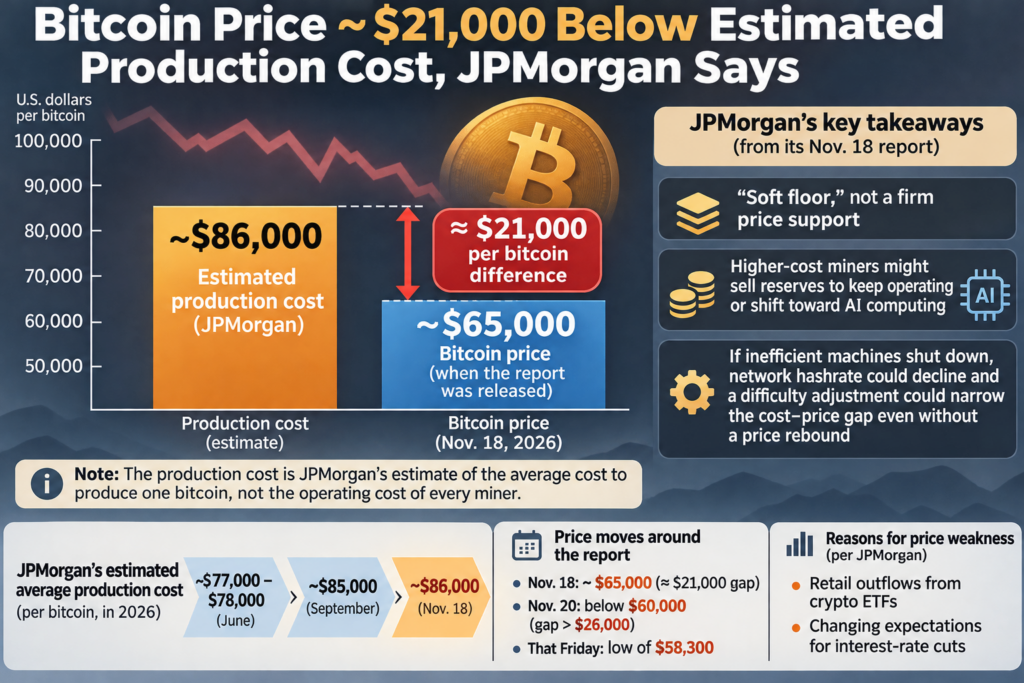
What happens when Bitcoin’s price falls below the estimated cost of producing it? In a November 18 report, JPMorgan put average production cost at about $86,000 per bitcoin, up from $77,000–$78,000 in June and $85,000 in September. These are the bank’s estimates, not the operating costs of every miner.
As reported on November 23, 2026, Bitcoin was trading near $65,000 when JPMorgan released its report—a gap of roughly $21,000 per coin. After the price fell below $60,000 on November 20, that gap widened to more than $26,000. Bitcoin reached a low of $58,300 that Friday.
JPMorgan described production cost as a soft floor, not a firm price support. It said higher-cost miners might sell reserves to keep operating or shift toward AI computing. If inefficient machines shut down, a decline in network hashrate followed by a difficulty adjustment could narrow the estimated cost-price gap even without a price rebound. The bank attributed Bitcoin’s price weakness to retail outflows from crypto ETFs and changing expectations for interest-rate cuts.