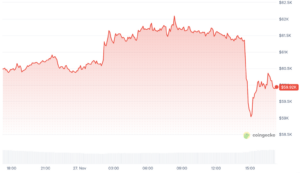
As of November 27, 2026, Bitcoin’s 50-day exponential moving average had fallen below its 200-day counterpart, but its 50-day simple moving average remained slightly above the 200-day average. Bitcoin itself was already trading below all four averages. On November 26, it traded at about $60,577, roughly 15.8% below the 200-day simple average of $71,977.
Why the two measures differ
A “death cross” occurs when the 50-day average falls below the 200-day average. A simple moving average gives each daily price in its window equal weight. An exponential moving average gives recent prices more weight, so it responds faster to a decline. By late November, Bitcoin’s 50-day exponential average was about $71,178, below the 200-day figure of about $74,447.
On the simple measure, the gap was narrowing, but the most recent 50-day crossover was still the September 8 “golden cross,” when the 50-day average rose above the 200-day average with Bitcoin at about $78,456. The shorter 21-day simple average had already fallen below the 200-day average in mid-November. A separate drop in the 50-day average below the 100-day average remained a possibility, not a confirmed crossover.
Price and ETF flows
Bitcoin traded between $60,000 and $62,000 in late November 2026, less than half its October 2025 peak of about $126,200. The previous simple-average death cross occurred on November 16, 2025, after that peak. US spot Bitcoin ETFs recorded roughly $5.39 billion in outflows in November 2026 through the time of reporting. The withdrawals coincided with the price decline but do not establish how much of it they accounted for.
Vivian Nguyen’s November 27 analysis identified $55,000 to $58,500 as a potential support zone below the trading range and the 200-day simple average near $71,977 as a reference level for a recovery. Neither level is a forecast. A crossover describes weakness already reflected in prices; historically, Bitcoin returns over periods of 90 days to a year after past crosses have often been positive, particularly when a cross occurred near a market-cycle low.