As of Tuesday, 24 November 2026, Bitcoin was reported at $60,518, down 1.3% over the prior 24 hours, after a Monday climb above $64,500 did not last. The bounce coincided with Nvidia reinstating Jensen Huang and a sharp rise in Nvidia shares. It faded as markets continued to price further Federal Reserve tightening. The figures below are observed prices, disclosed corporate actions and cited market readings from that report, not a forecast of miner revenue or a trading recommendation.
Monday’s Nvidia decision and the Bitcoin bounce
On Monday, 23 November 2026, Nvidia said its board had unanimously approved Huang’s return as president, chief executive officer and board director, effective immediately. Board chair Harvey Jones said the decision reflected the board’s confidence in Huang’s ability to lead the company and to serve shareholders, employees, customers and business partners.
Huang said: “I am honored to return to NVIDIA and lead one of the most consequential technology companies in the world at the beginning of a new industrial revolution.”
US President Donald Trump was reported to have welcomed the decision in a Truth Social post and to have described the reinstatement as the correct course of action.
Nvidia shares rose about 35% that Monday. Bitcoin briefly moved above $64,500 as the rebound in artificial-intelligence equities coincided with stronger interest in risk assets. The same account said bearish cryptocurrency traders took substantial liquidations during the bounce.
What reversed by Tuesday
By the 24 November report, Bitcoin was back around $60,500, still down 1.3% over 24 hours, and below $61,000. Monday’s rally and the later drop were reported to have wiped out about $821 million in leveraged positions. CoinGlass attributed $478 million of that total to short positions and $342 million to long positions.
The larger share of short liquidations was cited as a possible contributor to the upward move, through forced closures. The subsequent fall back below $61,000 was read as evidence that buying beyond those liquidations may have been too thin to sustain the rally. That is an interpretation of the price path, not a separate measure of spot demand.
On-chain losses and the December rate pricing
CryptoQuant said Bitcoin’s unrealized profit-and-loss margin among active traders dropped below −20% in the week before the 24 November report. It has associated readings at that level with periods of investor distress and with earlier phases in which markets later formed a bottom. The firm also said many active participants were holding Bitcoin at large unrealized losses after a prolonged correction. It cautioned that these bottoming formations have typically taken at least two months to develop before a durable recovery. That is a historical observation from CryptoQuant, not a statement that a bottom was already in place.
Minutes from the Federal Reserve’s October policy meeting, released the week before this report, were described as showing that almost all policymakers considered additional interest-rate increases appropriate while inflation pressures persisted. That is what the minutes were reported to contain. It is not itself a rate decision. The CME FedWatch Tool showed markets pricing a 99% probability that the Fed would raise rates by 25 basis points at its December meeting. Tighter policy was described as something that could restrict liquidity and weaken Bitcoin demand, and that could offset any support from recovering technology shares. Those effects were conditional, not observed changes in Bitcoin volume or network fees.
Levels on the daily chart
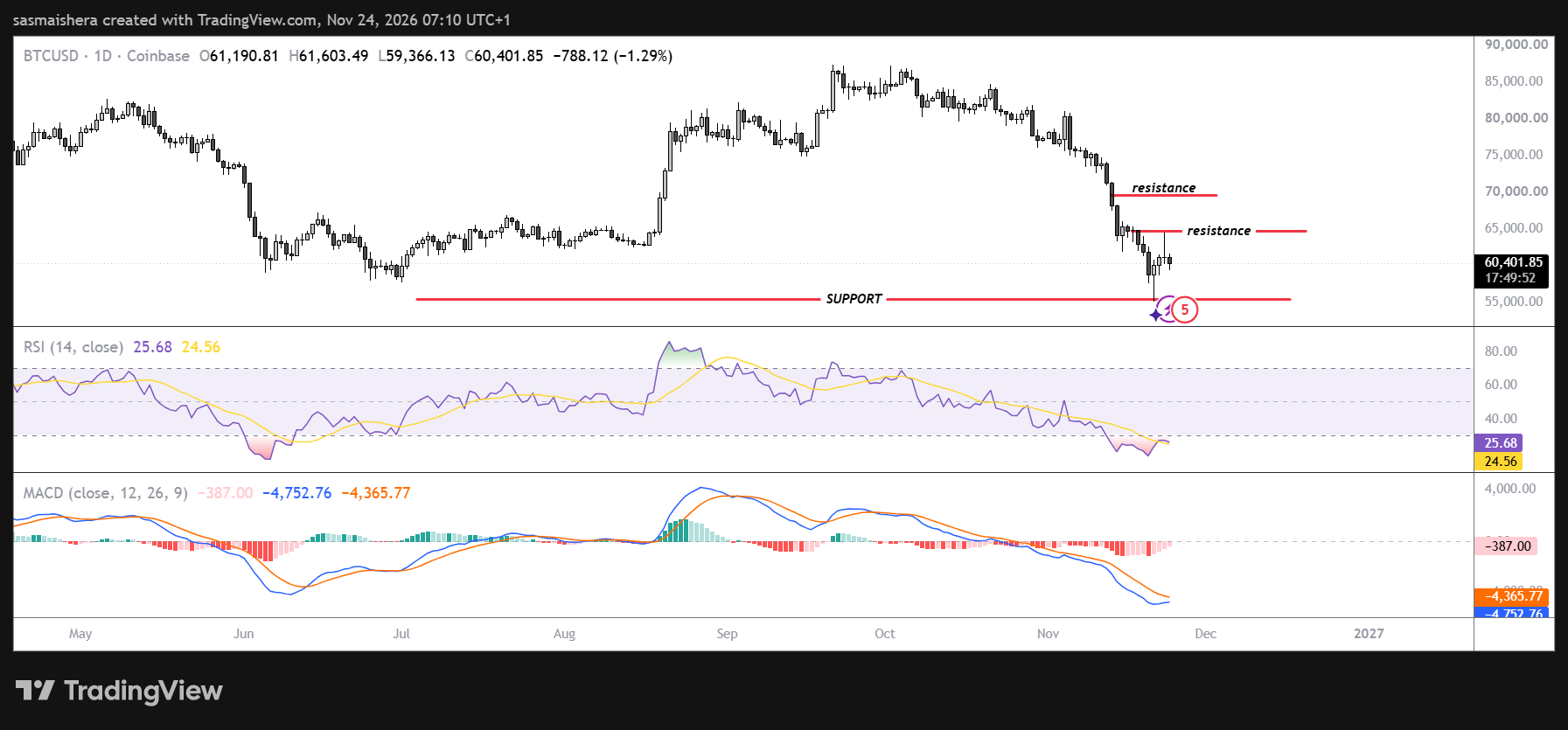
The BTC/USD daily chart was still described as bearish after Monday’s rally. Price was reported to have failed at resistance near $64,700 and then fallen below $61,000. Momentum readings cited with that chart had the MACD lines still in negative territory and the RSI at 24, treated in the note as oversold.
The same technical note set out scenarios, not completed moves. If the decline continued, it said Bitcoin would likely retest the prior weekend low of $55,130, while buyers would likely defend nearer support at $58,438 over the following sessions. If buyers regained control, it said price could retest $64,700, with $70,000 the next major level beyond that. Until one of those levels broke, the note expected choppy trading. The weekend low was not tied to a single calendar day in the report.