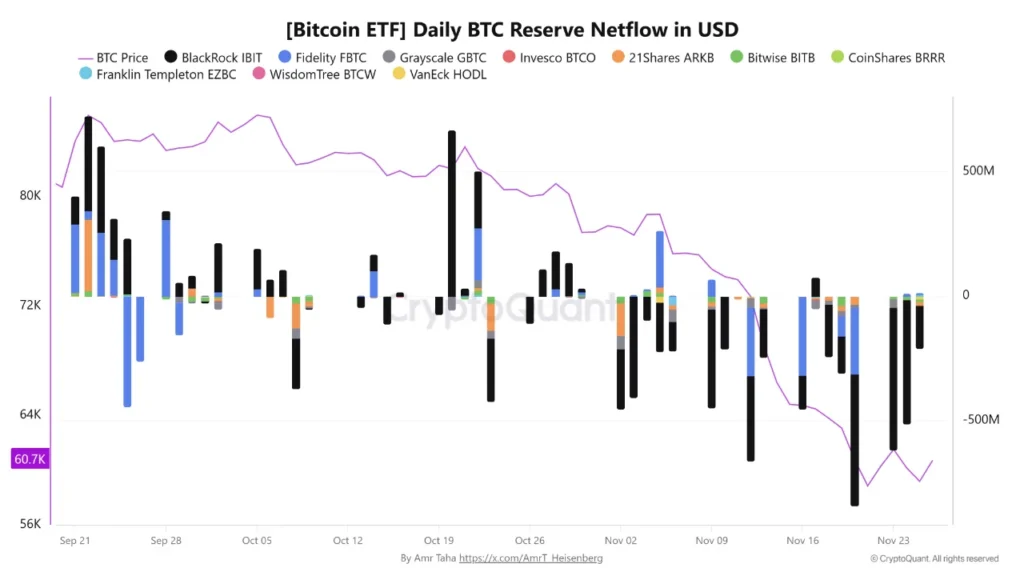
Did BlackRock’s iShares Bitcoin Trust (IBIT) sell the bitcoin that left wallets linked to the fund? CryptoQuant analyst Amr Taha estimated that $1.248 billion in bitcoin moved out of wallets he attributes to IBIT on Nov. 23–25, 2026. Farside Investors recorded $1.014 billion in net outflows from the fund over those dates. The figures align more closely when fund flows are compared with wallet movements a day later, but neither measure shows how much bitcoin the trust sold.
Why a redemption need not involve a sale
When one investor sells IBIT shares to another on an exchange, the trust’s bitcoin stays in custody. A redemption is different: an authorized participant, typically a large broker-dealer, returns a basket of shares to the trust. For a cash redemption, the trust sells the corresponding bitcoin through Coinbase Prime or an eligible trading counterparty and pays the participant in dollars. For an in-kind redemption, the trust delivers bitcoin without selling it. The participant may sell it later.
The SEC cleared in-kind creations and redemptions for IBIT on July 29, 2025. In the quarter ended Sept. 30, 2026, the trust delivered $2.04 billion in bitcoin against $2.67 billion in total redemptions, or about 76%, according to its quarterly filing. The November split was not disclosed.

Comparing fund flows with next-day wallet transfers
Farside records net creations and redemptions by trading session. Taha tracks when bitcoin moves on-chain. Because orders settle after the session in which they are placed, the wallet movement can appear later than the reported fund outflow. Three sessions illustrate the timing difference:
| IBIT trading session | Net fund outflow (Farside) | Next-day wallet outflow (Taha) | Wallet estimate relative to fund outflow |
|---|---|---|---|
| Nov. 19 | $541.1 million | $511.0 million on Nov. 20 | −5.6% |
| Nov. 23 | $509.3 million | $501.0 million on Nov. 24 | −1.6% |
| Nov. 24 | $175.3 million | $174.0 million on Nov. 25 | −0.7% |
The issuer’s share count provides an independent check for Nov. 24. iShares listed 1,329,760,000 shares outstanding on Nov. 24 and 1,324,560,000 on Nov. 25. Its fact sheet says the counts reflect the prior day’s positions, so the decline of 5.2 million shares corresponds to the Nov. 24 session. At 40,000 shares per basket, that represents 130 baskets. Using the Nov. 25 basket size of 22.63 BTC gives about 2,942 BTC. At the Nov. 24 closing price of about $59,744 reported by CryptoQuant, that was roughly $176 million, within $1 million of Farside’s figure.
The dates at either end help explain why the three-day totals differ by about $234 million. Taha put the Nov. 23 wallet outflow at $573 million; he had already identified about $572 million by 15:43 UTC, before the U.S. session closed. Those transfers could not have settled that session’s redemptions. Under the one-day interpretation, they would correspond to Friday, Nov. 20, when U.S. spot bitcoin ETFs as a group recorded $669.2 million in net outflows. At the other end, IBIT’s $329.7 million fund outflow on Nov. 25 would settle outside Taha’s window.
Three pairs do not prove that particular transfers settled particular orders. The wallet attribution is Taha’s, dollar estimates depend on the bitcoin price used, and the Nov. 19 match is less precise. A wallet outflow near $330 million on Nov. 26 or the next business day, given the U.S. Thanksgiving closure, would support the timing explanation. A substantially different figure would weaken it.
A separate $1.254 billion figure from Farside covers all tracked U.S. spot bitcoin ETFs on Nov. 23–25. Its resemblance to Taha’s $1.248 billion estimate is not confirmation: IBIT accounted for about 81% of the group’s net outflow, not all of it.

Coinbase Prime inflows do not identify the settlement method
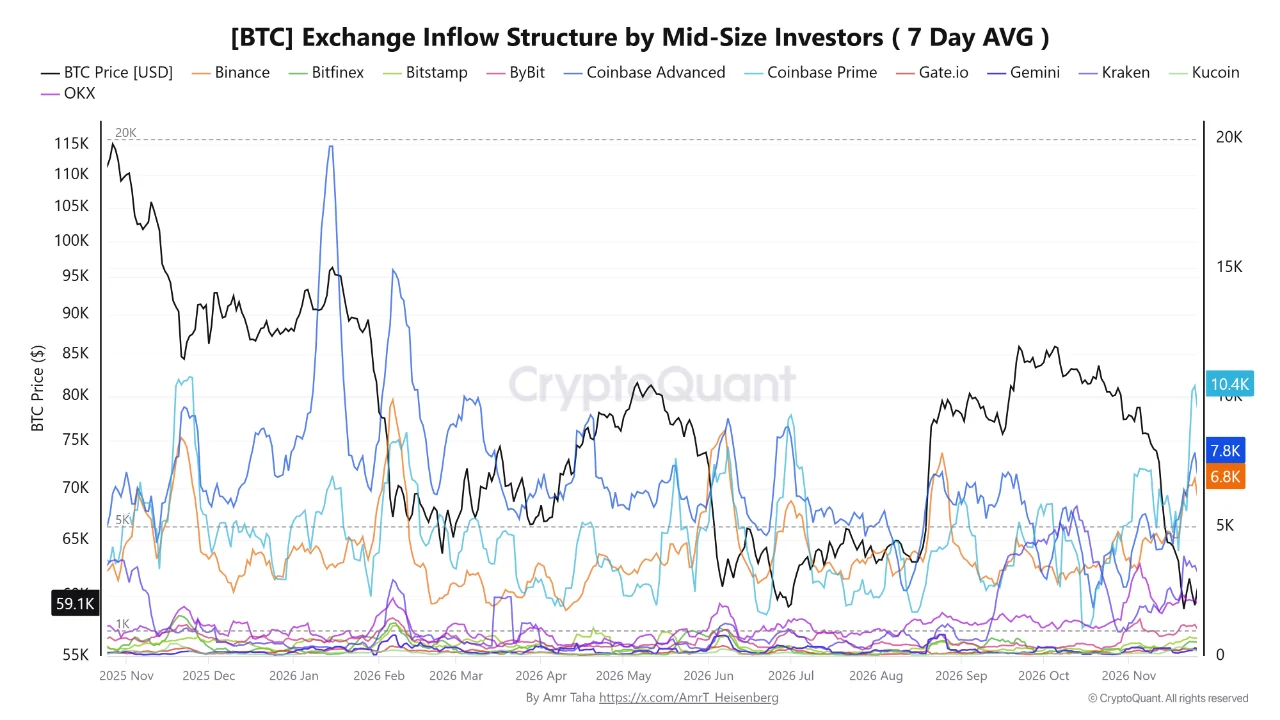
On Nov. 25, the seven-day average of bitcoin inflows to Coinbase Prime from wallets CryptoQuant classifies as mid-sized investors reached 10,400 BTC. That was the highest since November 2025 and about 2.8% below the earlier peak near 10,700 BTC. Taha suggested IBIT transfers may have contributed but did not identify which transfers were included. Coinbase Prime handles both custody and trading, so a deposit there is consistent with either a cash-redemption sale or delivery of bitcoin in kind.
Bitcoin rose about 5.4% early on Nov. 23 before giving back the gain during U.S. trading. Without a daily breakdown of cash and in-kind redemptions, the data do not establish whether sales by the trust contributed to that reversal. Comparing IBIT’s 2026 Form 10-K with the nine-month figures in its September filing could reveal the settlement split for October through December, but not for any individual session.