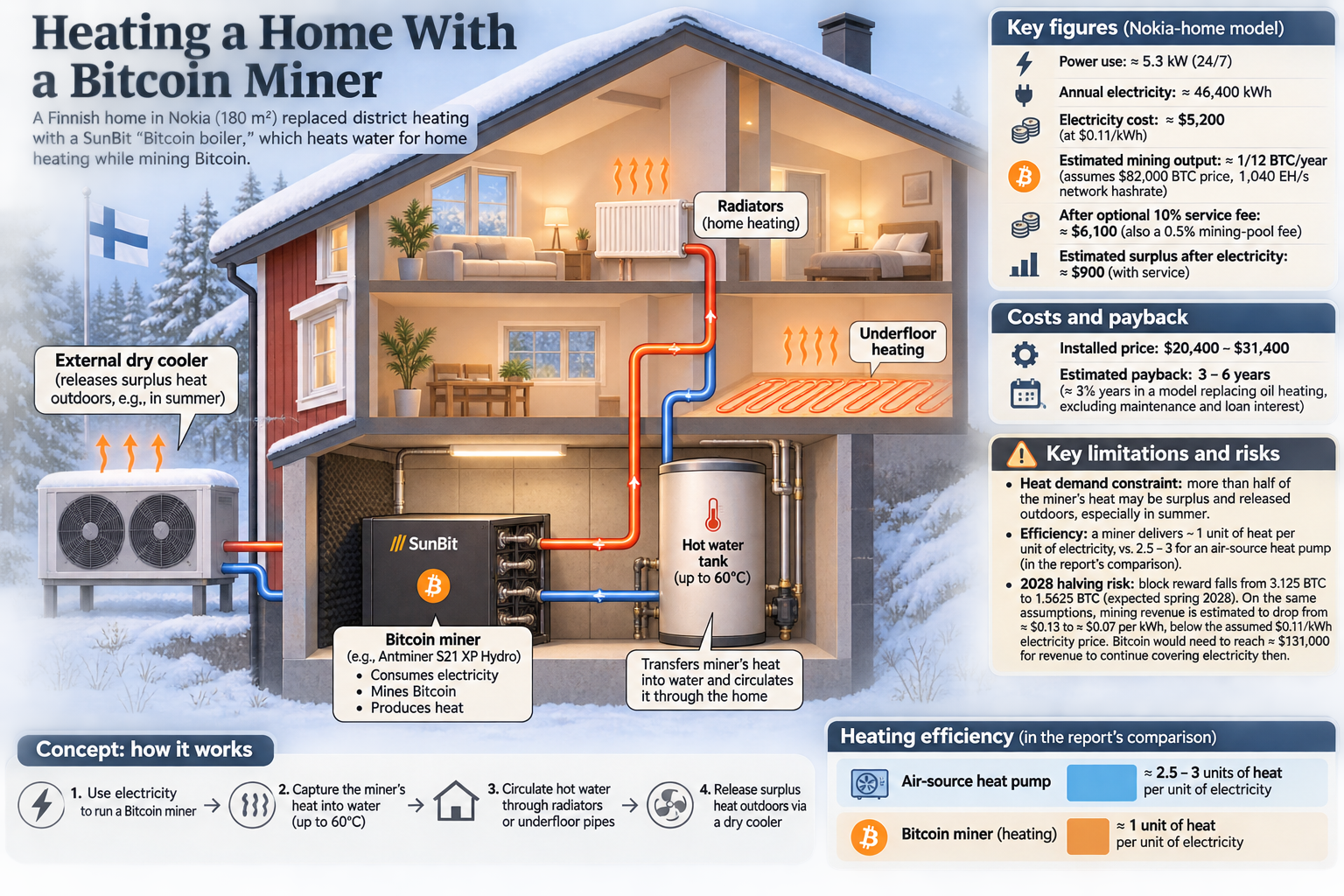
Can a household use a Bitcoin miner’s heat without paying more to run it than the machine earns? A report published on November 9, 2026 describes a 180-square-meter home in Nokia, Finland, that disconnected from district heating and now relies on a SunBit mining system. The heat is real; the claim that it can offset its running cost depends on mining revenue.
How the system works
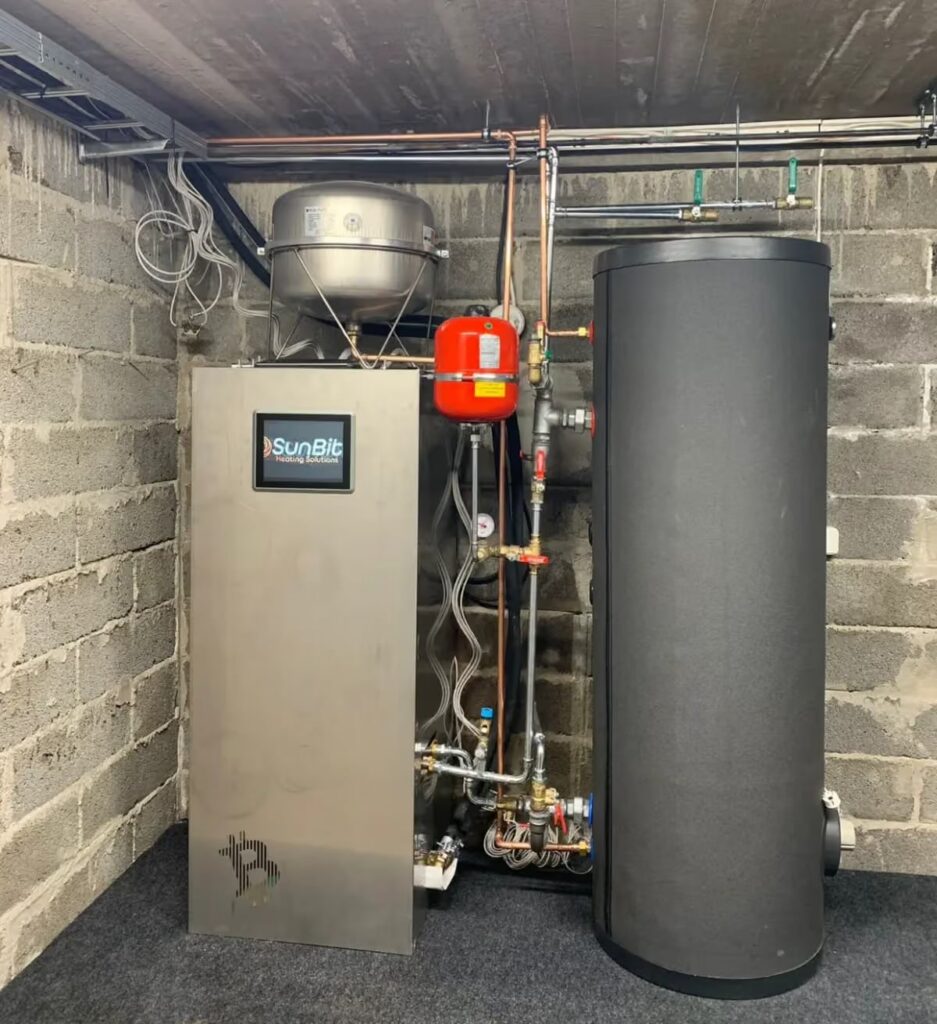
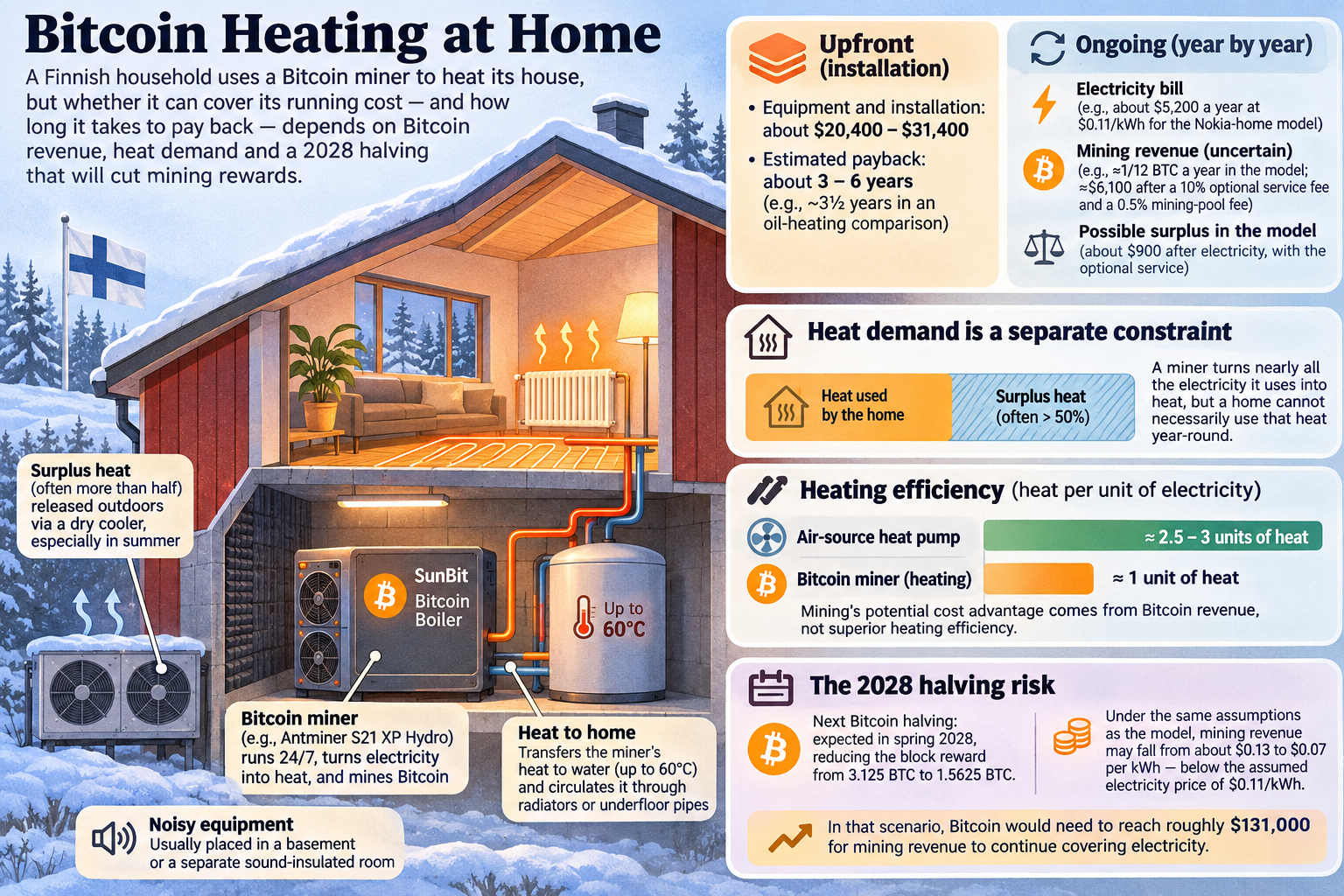
SunBit’s “Bitcoin boiler” transfers heat from a miner into water heated to as much as 60°C, then circulates it through radiators or underfloor pipes. The homeowner buys the equipment, pays the electricity bill and keeps the Bitcoin mined. Because the machines are noisy, they are generally placed in a basement or a separate sound-insulated room.
CEO Elmeri Suomi told CoinDesk that SunBit delivered its first production units in 2025 and had 30 systems operating at the time of the report. All but one were in Finland. The installations included homes replacing or reducing oil, gas, wood or district heating, as well as an industrial building. These are operating examples, not evidence that every home can use all the heat a miner produces.
Running costs versus installation costs
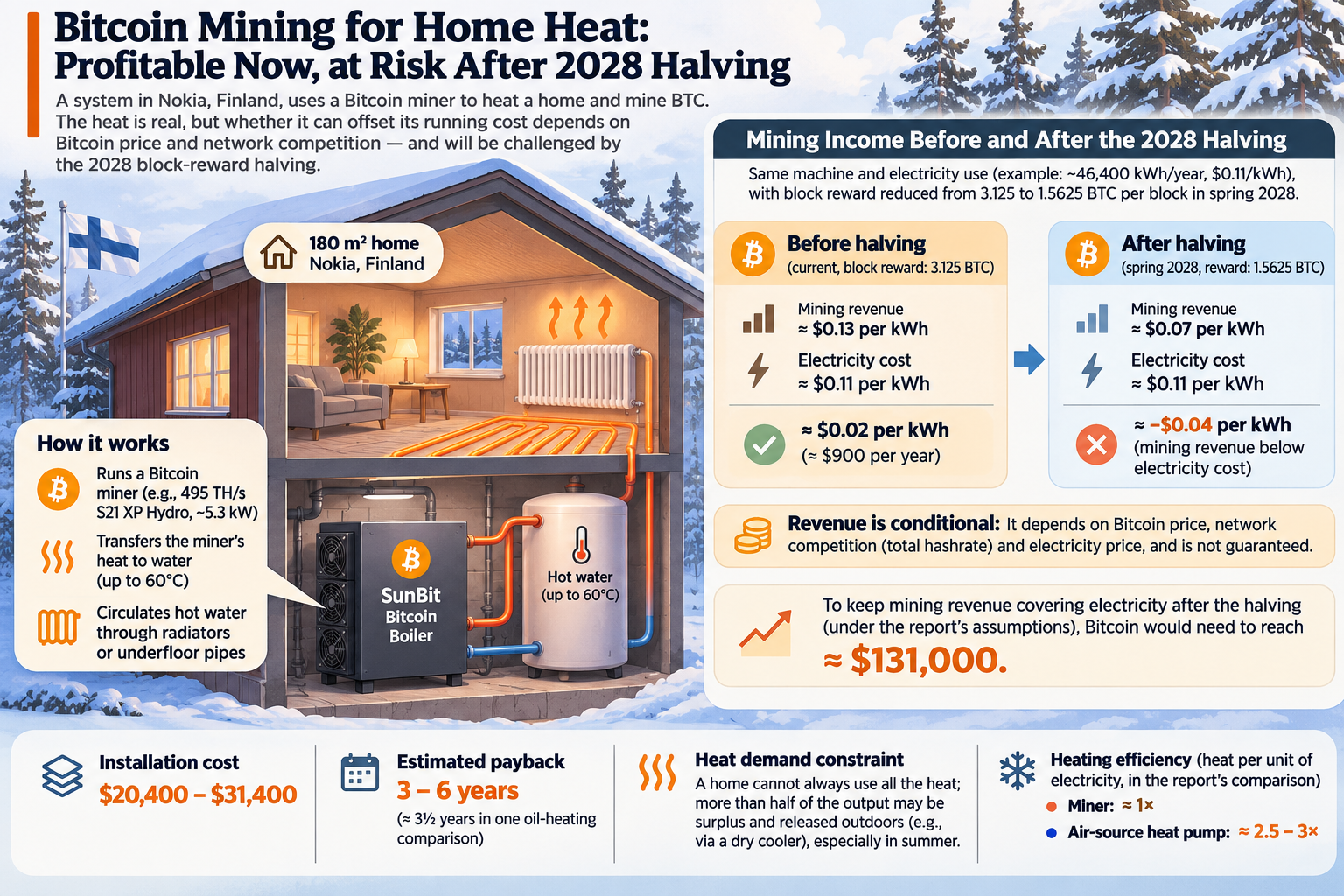
For its Nokia-home model, SunBit used a 495 TH/s Antminer S21 XP Hydro running Braiins OS. At approximately 5.3 kW around the clock, it would consume about 46,400 kWh a year. SunBit put annual electricity costs at roughly $5,200, using $0.11/kWh.
The revenue side was a projection, not a measured result for that machine: at a Bitcoin price of $82,000 and network hashrate of 1,040 EH/s, SunBit estimated output of about 1/12 BTC a year. After its optional 10% service fee, that was worth roughly $6,100 at the assumed price; the source also notes a 0.5% mining-pool fee. On those assumptions, SunBit estimated approximately $900 left after electricity costs. Without the optional service, it estimated the Bitcoin’s value at about $6,800 before electricity costs.
That margin does not repay the equipment. The report gives an installed-price range of $20,400–$31,400 and an estimated payback period of three to six years. In a separate oil-heating comparison, SunBit used about $20,200 for installation and estimated roughly 3½ years to pay back the system by combining avoided fuel spending with projected mining surplus, excluding maintenance and loan interest.
There was one reported customer result, but it used different hardware: Suomi supplied a pool-account screenshot showing that an early customer’s 358 TH/s S21+ Hydro mined 0.039 BTC over the preceding year, worth about $3,160 at the price used in the report. SunBit said that system could replace approximately 2,000 liters of heating oil annually. The company could see data for early pilot users, but not for later customers using private pool accounts.
Heat demand is a separate constraint
A miner turns nearly all the electricity it consumes into heat, but a home cannot necessarily use that heat year-round. The report says more than half the system’s output may be surplus and released outdoors through an external dry cooler, particularly in summer. An air-source heat pump, by contrast, can deliver 2.5–3 units of heat per unit of electricity under the comparison in the report; a miner delivers about one. Mining’s potential cost advantage comes from Bitcoin revenue, not superior heating efficiency.
The 2028 revenue risk
The next Bitcoin halving was expected in spring 2028, reducing the block reward from 3.125 BTC to 1.5625 BTC. SunBit’s payback calculator, according to the report, did not include that event, and the company did not promise a fixed return. Holding the model’s other assumptions constant, the report estimated mining revenue would fall from about $0.13 to $0.07 per kWh consumed—below its assumed $0.11/kWh electricity price. It calculated that Bitcoin would need to reach roughly $131,000 for mining revenue to continue covering electricity under that scenario. Changes in network competition, electricity prices or Bitcoin prices would change the result; the system would still produce heat.
Source: techflowpost.com (originally published 2026-11-09 18:07 UTC+8)