Can a Bitcoin miner cover a home’s heating bill—and repay the cost of installing it? In a report published on November 9, 2026, SunBit described Finnish installations that use miners’ heat for space heating and hot water. Its payback estimates, however, depend on electricity prices, Bitcoin revenue and how much of the heat a building can use.
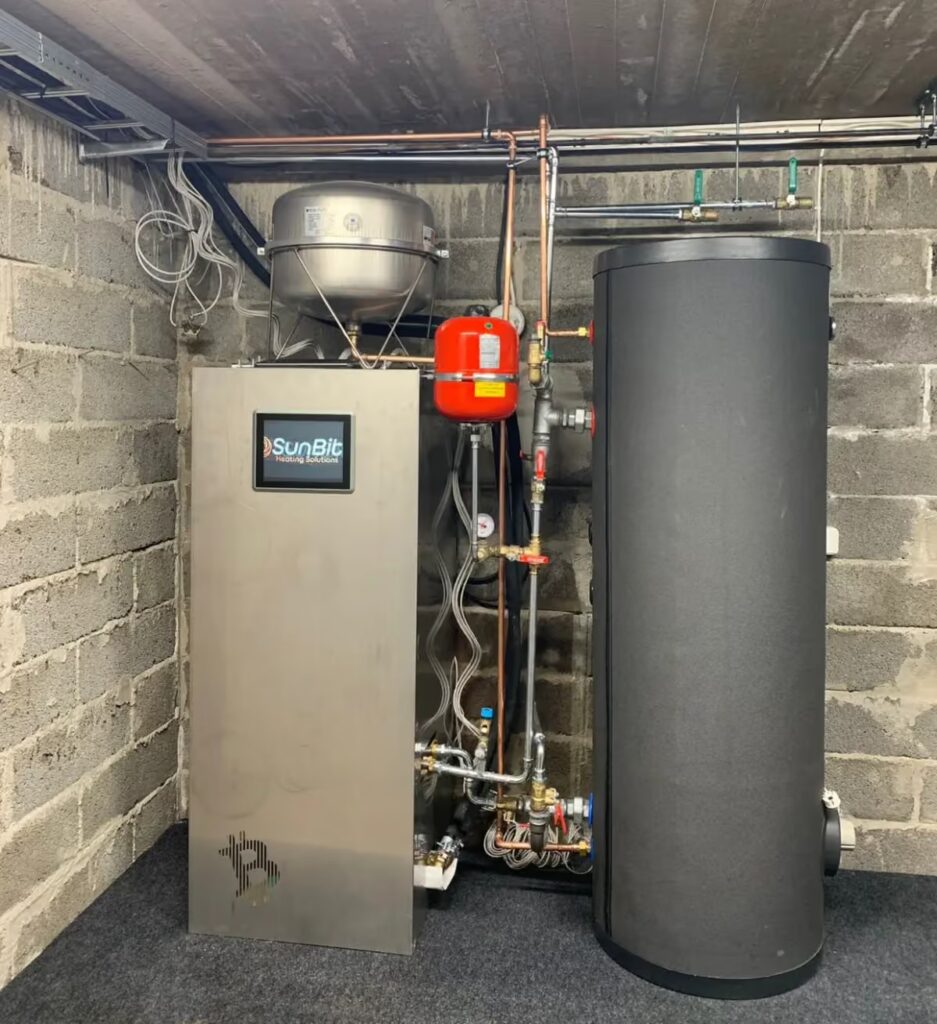
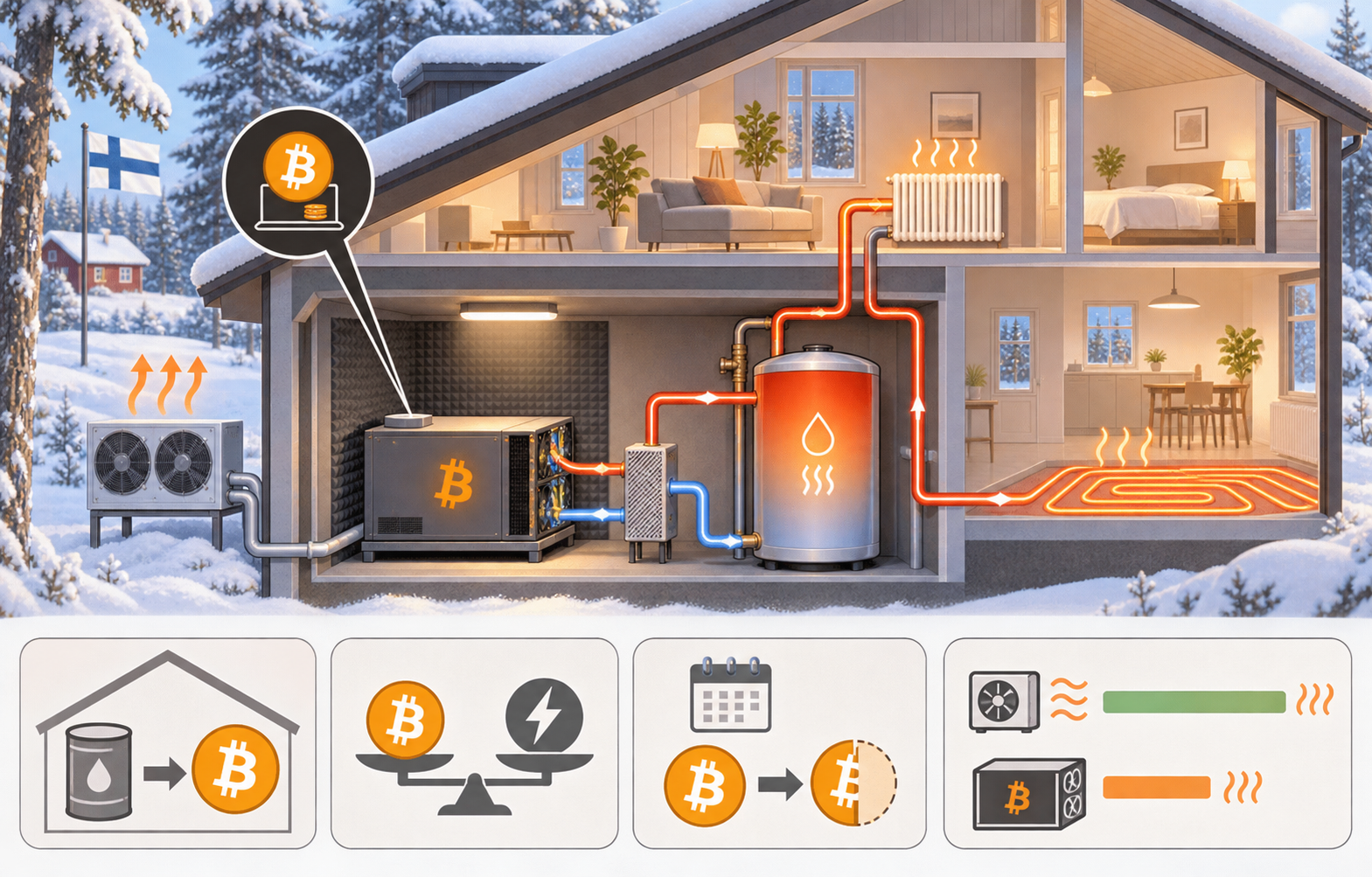
A 180-square-meter home in Nokia, Finland, has disconnected from district heating and now uses a SunBit system. The miner transfers heat into water at up to 60°C, which circulates through radiators and underfloor pipes. The homeowner owns the equipment, pays for its electricity and keeps the Bitcoin mined. Because miners are noisy, they are generally placed in a basement or a separate sound-insulated room.
SunBit CEO Elmeri Suomi told CoinDesk that the company delivered its first production systems in 2025 and had 30 operating at the time of the report, all but one in Finland. A Dutch installation replaced gas heating in 2025. Other reported uses include a Finnish home pairing a miner with an oil boiler, a manor heating a 1,500-liter water tank, and a 3,000-square-meter industrial building combining mining heat with an air-source heat pump and surplus electricity from a 30 kW solar array.
Running costs versus purchase cost
SunBit’s model for the Nokia home uses an Antminer S21 XP Hydro rated at 495 TH/s, running Braiins OS at about 5.3 kW around the clock. It estimates roughly 46,400 kWh of annual electricity use and an annual bill of about $5,200 at $0.11/kWh.
At an assumed Bitcoin price of $82,000 and network hashrate of 1,040 EH/s, SunBit estimates annual output of about 1/12 BTC. After its optional 10% service fee, the model puts the homeowner’s Bitcoin revenue at about $6,100; a mining pool also charges 0.5%. On those assumptions, the reported surplus after electricity is roughly $900 a year. Without SunBit’s service, the model values the full 1/12 BTC at about $6,800. The service includes remote monitoring, responses to Finland’s variable electricity prices and an app.
These are modeled returns, not observed annual results for the Nokia home, and they exclude the purchase and installation cost. Suomi also supplied a pool-account screenshot for an early customer with a 358 TH/s S21+ Hydro: it showed 0.039 BTC mined over the preceding year, worth about $3,160 at the price used in the report. SunBit said that installation could replace roughly 2,000 liters of heating oil annually. The company said it cannot see the pool accounts of later customers.
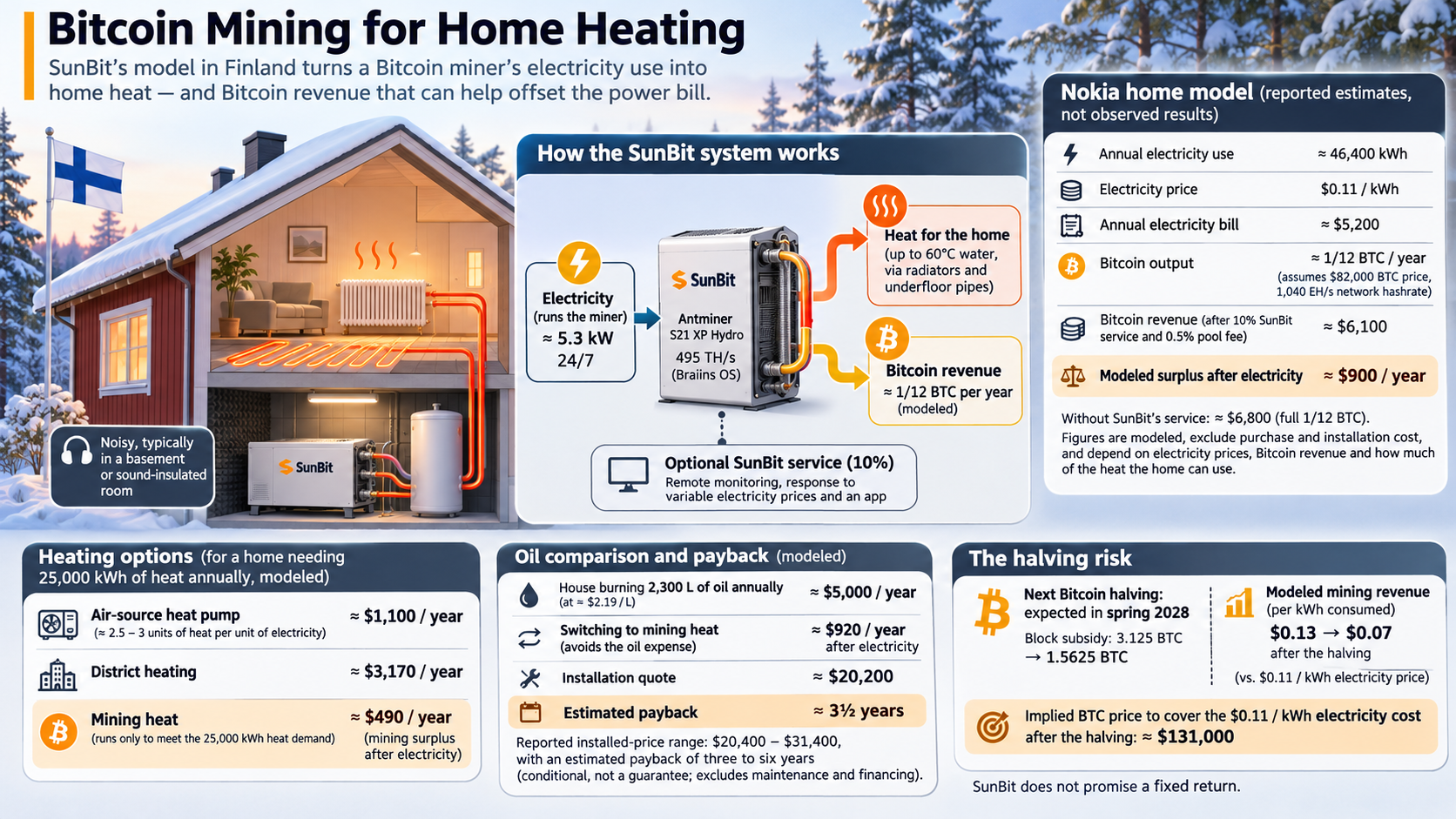
For a separate comparison, SunBit modeled a house burning 2,300 liters of oil annually at about $2.19 per liter, or roughly $5,000 a year. It estimated that switching to mining heat would avoid that oil expense and leave about $920 a year after mining electricity costs. Against an installation quote of about $20,200, SunBit estimated payback at roughly 3½ years, excluding maintenance and financing. The report also gives a broader installed-price range of $20,400–$31,400 and estimated payback of three to six years. Those projections are conditional, not guarantees.
Heat use and the halving risk
A miner converts approximately one unit of electrical energy into one unit of heat. A heat pump can deliver about 2.5–3 units of heat per unit of electricity by moving heat from its surroundings. Mining revenue—not heating efficiency—is what could offset the miner’s higher power use. SunBit’s model for a home needing 25,000 kWh of heat annually puts air-source heat-pump running costs at about $1,100, versus $3,170 for district heating. It estimates a $490 mining surplus after electricity if the miner runs only long enough to meet that heat demand.
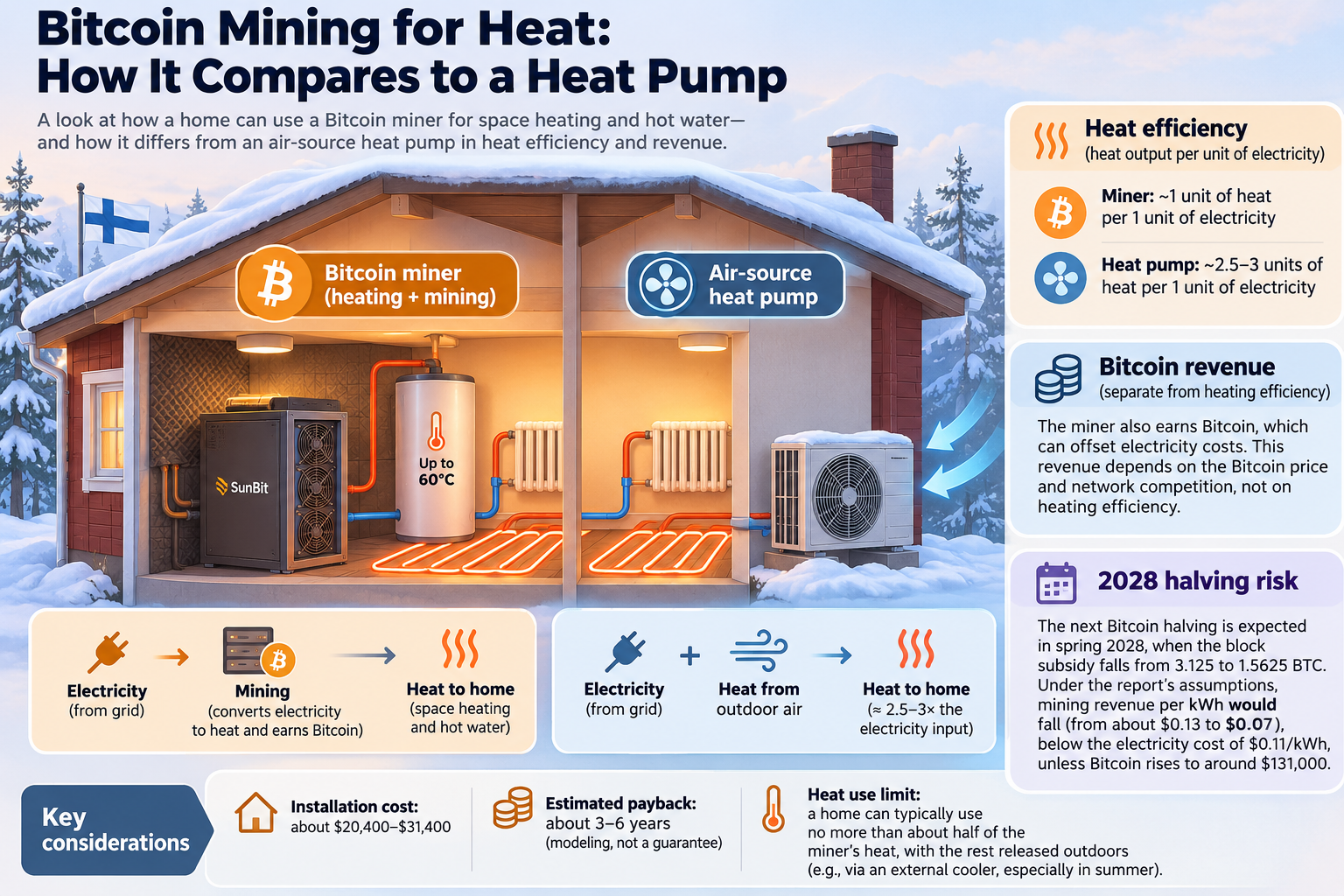
Using all the output is another constraint: the report says a home cannot consume more than half of the modeled miner’s heat, with an external cooler releasing the excess outdoors, particularly in summer. Suomi argued that mining heat output remains steady in severe cold, unlike an air-source heat pump’s efficiency. That does not remove the miner’s exposure to Bitcoin prices and network competition.
The next Bitcoin halving was expected in spring 2028. The block subsidy would fall from 3.125 to 1.5625 BTC. SunBit’s payback calculator did not incorporate that change. Holding the model’s other assumptions fixed, the report estimated mining revenue falling from $0.13 to $0.07 per kWh consumed—below its assumed $0.11/kWh electricity price. It calculated that Bitcoin would need to reach about $131,000 for mining revenue to cover that electricity cost after the halving. Suomi said SunBit does not promise a fixed return.
Source: panewslab.com (originally published 2026-11-09 21:49 UTC+8)