
As of the original report on Nov. 9, 2026, analysts saw little evidence that the $6.3 billion Binance hack was spreading into a broader crypto-market crisis. The assessment rests partly on Binance’s pledge to cover user losses—not on a claim that the breach had no market impact.
Attackers stole about $6.3 billion from Binance hot wallets in the Oct. 29 breach, reported as the largest crypto hack to date. Martin Lee, market insights lead at DWF Labs, told Cointelegraph that Binance’s ability to cover losses from its balance sheet appeared to be preventing a “contagion-type effect.” He said investors had shifted their attention to the implications of the US midterm elections.
DefiLlama data showed Binance’s daily net outflows at $458 million in the 24 hours before the Nov. 9 report, down from $6.1 billion on Nov. 2, after withdrawals resumed.
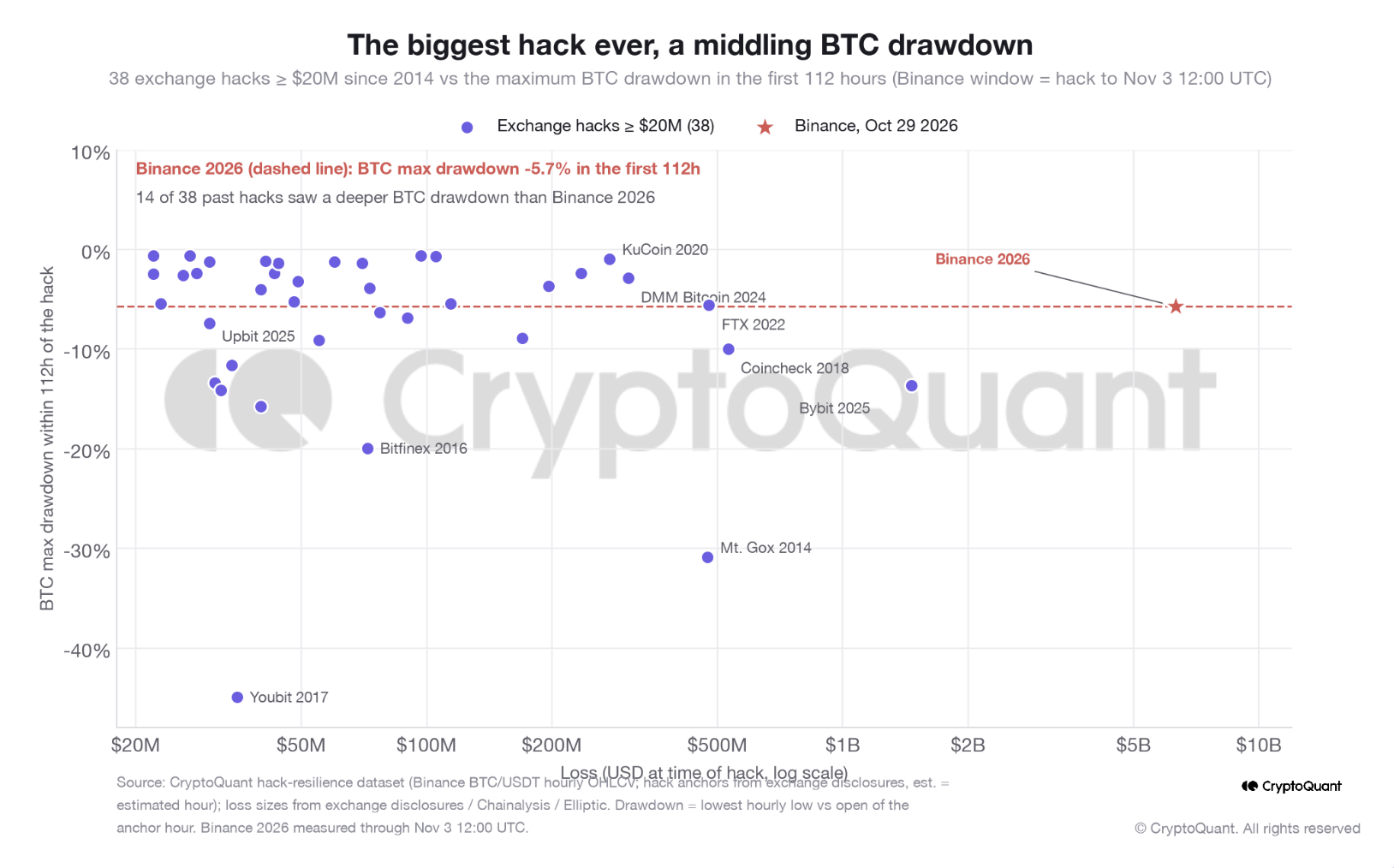
Bitcoin fell as much as 5.7% in the first five days after the hack. CryptoQuant called that decline “modest” compared with drops of roughly 13.6% after the $1.4 billion Bybit hack in 2025 and 9.9% after the Coincheck hack in 2018. At least 14 of the 38 past hacks CryptoQuant reviewed were followed by steeper Bitcoin declines. Lacie Zhang, research lead at Bitget Wallet, said the Binance breach did not represent a structural reversal for crypto markets.
The outlook remained uncertain. Bitfinex analysts said confirmation of a Bitcoin market bottom depended on the US consumer price index reading due Nov. 10, which could influence the Federal Reserve’s next rate decision. CME Group’s FedWatch tool showed market participants pricing an 80% chance of a rate increase at the Dec. 9 meeting, up from 69% a month earlier. Bitcoin was down 2.5% over 24 hours at $74,580 as of 1:21 p.m. UTC on Nov. 9, according to CoinMarketCap.